Physical Address
Lahore, Pakistan
Physical Address
Lahore, Pakistan
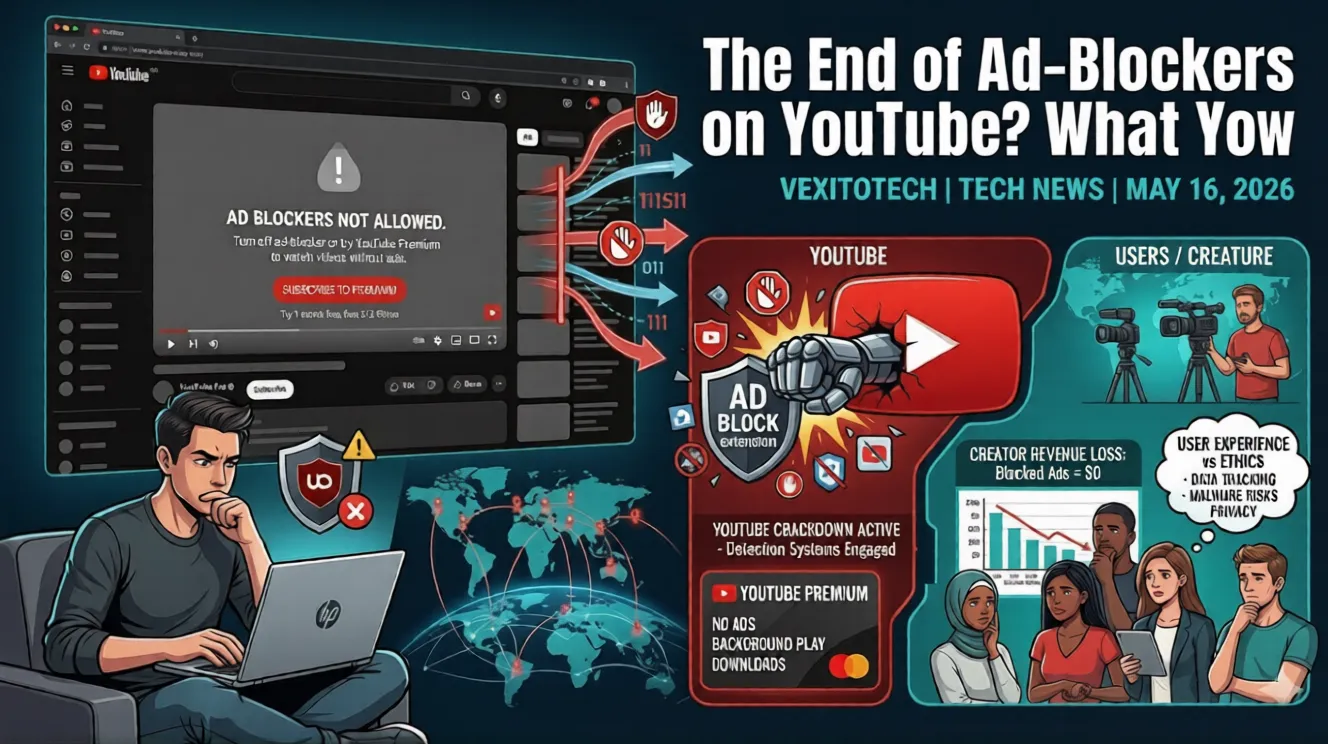
YouTube has been quietly waging a war against ad-blockers for a while now — and lately, it feels like they’re winning. Here’s everything you need to know, explained simply.
By Vexitotech | May 16, 2026
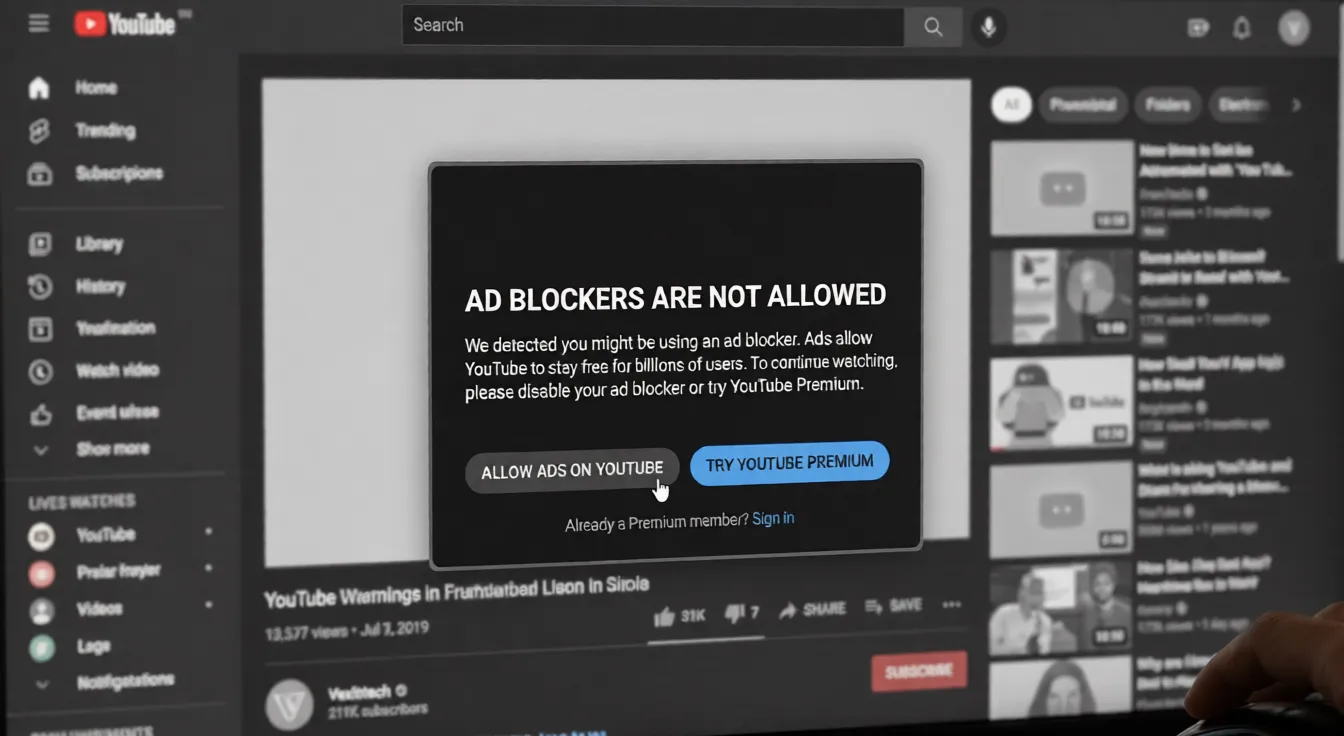
If you use an ad-blocker on YouTube, you’ve probably already seen the warning. Maybe it popped up once and you clicked past it. Maybe it showed up again. And then again. And then one day, the video just… didn’t play. You sat there staring at a grey screen with a message telling you that ad-blockers aren’t allowed on YouTube and that you need to either turn it off or pay for Premium.
It’s frustrating. And a lot of people have questions. Is YouTube actually going to block ad-blockers permanently? Why is this happening now? What can you actually do about it? Is there any way to keep watching for free without sitting through five ads every ten minutes?
Let’s go through all of it — no tech jargon, no fluff, just straight answers.
Before we get into YouTube’s crackdown, it helps to understand why people use ad-blockers in the first place. And the honest answer is: because ads on the internet got really, really bad.
Back in the early days of the web, ads were annoying but mostly harmless — a blinking banner here, a pop-up there. But over the years, ads got more aggressive. They started playing loud audio automatically. They covered the entire screen. They tracked your every move across the internet to build a detailed profile of your interests, your habits, and your location. Some ads even carried malware that could infect your computer just by being displayed.
So people fought back. Ad-blockers became one of the most downloaded browser extensions in history. By the early 2020s, hundreds of millions of people worldwide were using them. And who could blame them?
YouTube, of course, is an ad-supported platform. That means the entire business model depends on you watching ads. Every time you sit through a fifteen-second pre-roll ad before a video, YouTube makes money. That money pays the bills — and a chunk of it goes to the creators whose videos you’re watching. When you block those ads, YouTube makes nothing. And the creator makes nothing either.
So from YouTube’s perspective, ad-blockers aren’t just inconvenient — they’re a direct threat to the entire ecosystem.
YouTube didn’t just wake up one morning and decide to go to war with ad-blockers. This has been building for years. But around 2023, things started getting serious.
YouTube began rolling out a system that detects whether you have an ad-blocker running in your browser. If it does, you get a warning. The first time, it’s fairly gentle — a message asking you to disable your ad-blocker or consider YouTube Premium. The second time, it’s firmer. By the third strike, many users reported that videos simply stopped loading altogether.
This detection system caused a lot of frustration — and a lot of news coverage. Tech forums were flooded with people sharing workarounds. Ad-blocker developers scrambled to update their tools to dodge YouTube’s detection. It became a genuine cat-and-mouse game, with YouTube patching holes and ad-blocker developers finding new ways around each patch.
By 2024, YouTube had gotten significantly better at detection. Some of the most popular ad-blockers — including certain configurations of uBlock Origin — were being caught more reliably. Not every user was affected the same way, and the rollout was uneven, but the direction was clear: YouTube was serious about this, and they weren’t backing down.

You might be wondering — YouTube has tolerated ad-blockers for years. Why go so hard after them now?
A few reasons, and they’re all connected.
Streaming competition is intense. Netflix, Disney+, Amazon Prime, Apple TV+ — every major platform is fighting for your time and money. YouTube’s edge has always been that it’s free. But “free with ads” only works if people actually see the ads. If too many users are blocking them, the business case for “free” starts to fall apart.
YouTube Premium needs more subscribers. YouTube Premium — the paid, ad-free version of YouTube — has been around since 2018, but it never became the massive revenue stream that Google hoped for. Most people just… didn’t bother paying when they could get the same content for free with an ad-blocker. Cracking down on ad-blockers is, at least partly, a way to push people toward Premium. No ads for free? Fine. Then pay for no ads.
Creator payouts are under pressure. YouTube has been emphasizing its role in supporting creators — and that’s not entirely spin. The platform does pay out billions of dollars a year to content creators through its ad revenue sharing program. When ad-blockers reduce ad views, that revenue pool shrinks. Making this a creator-welfare issue (rather than just a corporate-greed issue) gives YouTube a more sympathetic angle to push.
Ad revenue is their core business. Google’s parent company, Alphabet, makes the overwhelming majority of its money from advertising. YouTube is a massive piece of that. There is no version of this where Google just shrugs and accepts billions in lost ad revenue.
What Happens If You Keep Using an Ad-Blocker?
Honestly, it depends on the ad-blocker you use and how YouTube’s detection system is working at any given time.
Some users still report that their ad-blockers work fine. Others get the warning message constantly. Others have found that YouTube now loads extremely slowly — some people suspect YouTube deliberately throttles loading speeds for users it suspects are running ad-blockers, though YouTube has officially denied this.
What’s clear is that the situation is not static. YouTube is actively working to close loopholes. Today’s workaround may not work tomorrow. If you’ve found a method that works right now, there’s no guarantee it will still work in a month.
The days of reliably, effortlessly blocking all YouTube ads through a standard browser extension are probably coming to an end — at least for most casual users who aren’t willing to go deep into technical workarounds.
Let’s be practical. Here’s what you can actually do.
Option 1: Just watch the ads. Look, this is the option YouTube wants. And honestly, for a lot of people, it might be the path of least resistance. YouTube has made some ads skippable after five seconds. If you’re watching on a topic you care about, the ads are at least somewhat targeted to your interests. It’s not ideal, but it’s where the platform is heading.
Option 2: Pay for YouTube Premium. YouTube Premium costs around $13.99 per month in the US (prices vary by country). You get no ads, background play (so videos keep playing when you lock your phone), offline downloads, and access to YouTube Music. If you watch a lot of YouTube, it’s genuinely not a bad deal. A family plan brings the per-person cost down considerably.
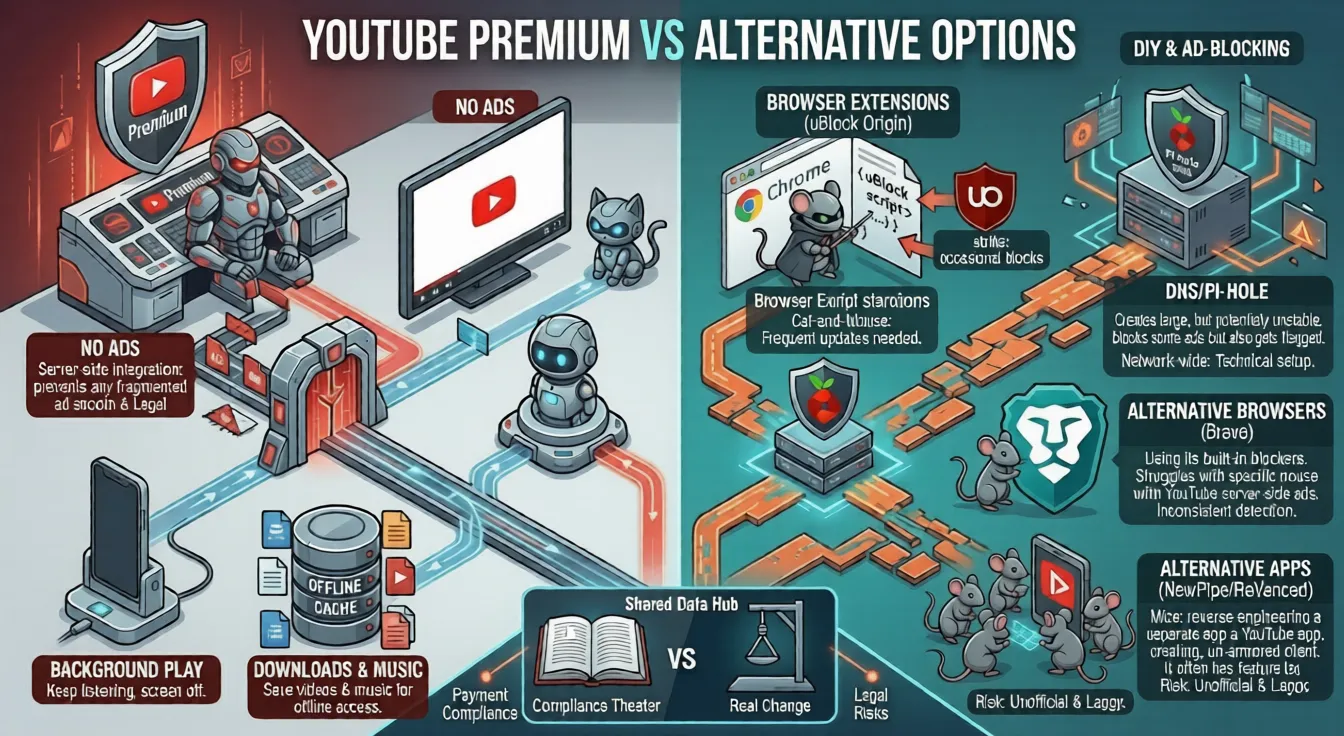
Option 3: Use a different browser or app configuration. Some people have had success using browsers with built-in ad-blocking features — Brave browser, for example, has its own ad-blocking system that, at various points, has been harder for YouTube to detect than browser extensions. Results are inconsistent and change frequently.
Option 4: Use a DNS-level ad blocker. Tools like Pi-hole or AdGuard DNS block ads at the network level rather than the browser level, which makes them harder to detect. Setting these up requires more technical knowledge and isn’t practical for the average person, but if you’re comfortable with home networking, it’s an option worth looking into.
Option 5: Watch YouTube through an alternative client. Apps like NewPipe (Android only, not on the official Play Store) let you watch YouTube content without ads and without YouTube’s official app. These apps exist in a legal grey area and aren’t supported by YouTube, so use them with awareness of the trade-offs.
This is where it gets genuinely complicated, and it’s worth sitting with the question honestly rather than just picking a side.
YouTube provides an enormous amount of free content. The infrastructure alone — the servers, the bandwidth, the moderation systems — costs billions of dollars a year to run. That money has to come from somewhere. Ads are how it comes. From that perspective, expecting to consume the content without engaging with the business model that funds it is… a hard position to fully defend.
On the other hand, the advertising industry spent years abusing user trust. Invasive tracking, manipulative targeting, loud auto-play ads, and malware-laced ad networks made ad-blockers feel like a form of self-defense rather than content theft. Users didn’t install ad-blockers because they hate creators — they installed them because the ad experience had become genuinely hostile.
The truth is probably somewhere in the middle. YouTube has a legitimate business case for wanting people to see ads. Users have a legitimate grievance about the history of invasive online advertising. Neither side is entirely the villain here.
For the average YouTube creator, this is a mixed picture.
On the positive side, if YouTube’s crackdown on ad-blockers actually succeeds in getting more people to watch ads or pay for Premium, that means more money flowing into the system — and potentially more money going to creators.
On the negative side, if the crackdown is too aggressive and drives people away from YouTube entirely — to other platforms or just to less screen time — that hurts creators by shrinking the audience.
Smaller creators are especially vulnerable. Big channels with millions of subscribers can absorb shifts in the platform. A creator with fifty thousand subscribers running on thin margins is much more exposed to any changes in how YouTube monetizes its content.
Step back for a moment, and this YouTube story is part of something much larger. It’s a fight over who gets to control your experience online.
For a long time, open web standards and user-installed tools gave individuals a lot of power to customize how they used the internet. You could install extensions, run scripts, and shape your browsing experience however you wanted. The web felt like something you had agency over.
That’s gradually changing. Platforms are becoming more closed. APIs are being locked down. Browser extensions are being restricted. The trend, across almost every major platform, is toward companies having more control over the user experience and users having less.
Ad-blockers are one small front in that larger battle. But the outcome here — whether users can meaningfully push back against how platforms monetize their attention — has implications well beyond YouTube.
YouTube isn’t going away. Ads on YouTube aren’t going away. And YouTube’s efforts to block ad-blockers aren’t going away either. If anything, they’re going to get more sophisticated over time.
If you want a completely ad-free YouTube experience and you want it to be reliable and easy, YouTube Premium is probably where you end up. If you’re willing to tinker and accept some inconsistency, there are still technical workarounds — for now. If you’re fine watching ads, well, YouTube would love you.
What’s clear is that the era of effortlessly blocking all ads on YouTube with a one-click browser extension is coming to a close. The platform has made its position clear, and it has the technical and legal resources to keep pushing.
The best thing you can do is understand your options, make a choice that fits your situation, and stop being surprised when things change. Because on the internet, they always do.
At the end of the day, YouTube built the platform, pays for the servers, and hosts the content. But you’re the one giving them your time and attention — and that has value too. How that trade-off gets negotiated is what all of this is really about.