Physical Address
Lahore, Pakistan
Physical Address
Lahore, Pakistan
Governments around the world are racing to write new rules for artificial intelligence — and those rules are already reshaping what we see, share, and do online.
By Vexitotech | May 16, 2026
Let’s be honest — most people don’t spend their mornings reading government policy papers. But here’s the thing: the laws being passed right now in Europe, the US, China, and dozens of other countries are quietly changing the internet you use every single day. They’re changing what news you see, how your face gets scanned, what chatbots are allowed to say to you, and even whether certain AI tools will be available in your country at all.
This isn’t some distant future thing. It’s happening right now. And once you understand it, you’ll start noticing it everywhere.
For a long time, the internet operated under a kind of “move fast and break things” philosophy. Tech companies built products, launched them globally, and figured out the problems later. Governments mostly stayed out of the way. The result? Social media algorithms that amplified outrage, data brokers selling your personal information, and deepfakes that could ruin someone’s reputation overnight.
AI has made all of that faster, cheaper, and more powerful. A single AI model can now write convincing fake news at scale, clone someone’s voice in seconds, or make hiring decisions for millions of job applicants. The stakes got too high for governments to keep looking away.
Think of it this way: governments regulated cars, banks, and pharmaceuticals when they became powerful enough to cause serious harm. AI is simply next in line.
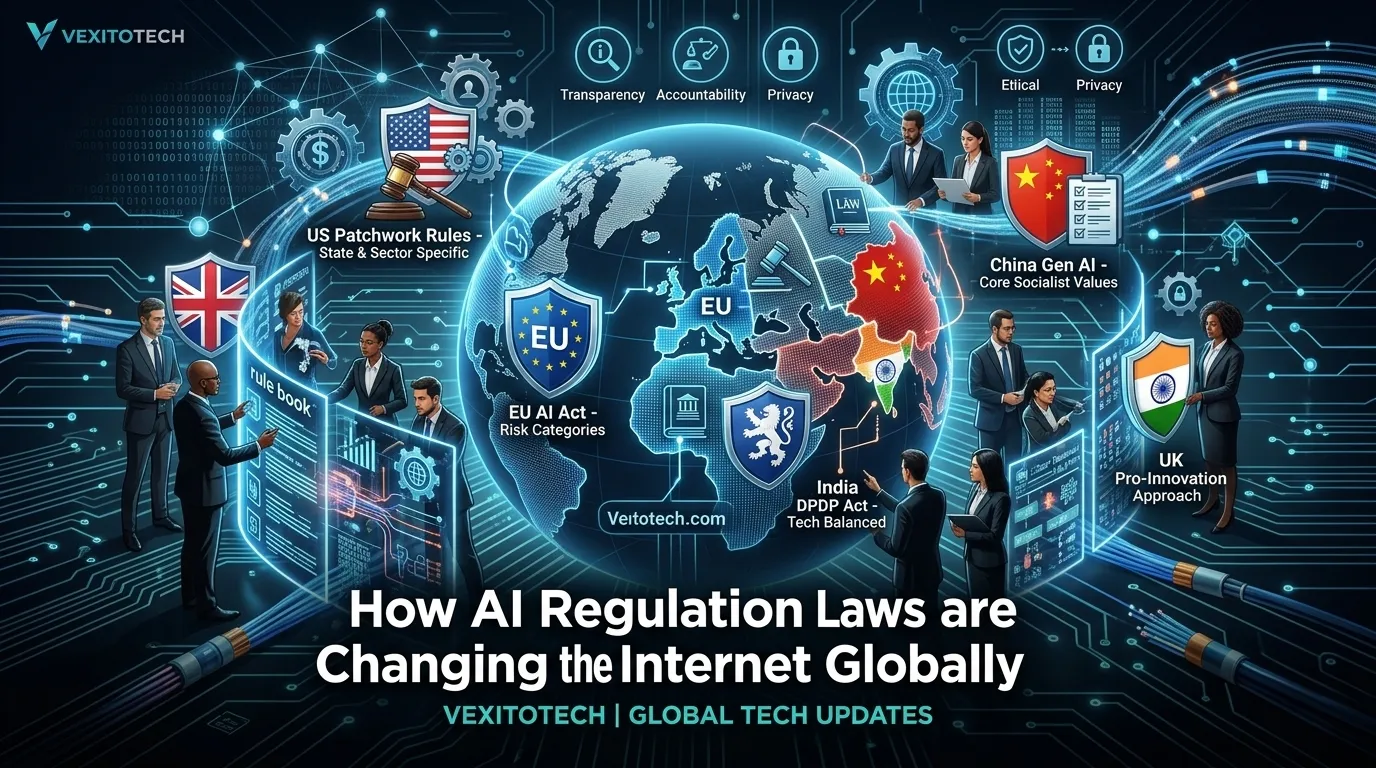
Europe moved first and moved boldly. The EU AI Act, which began rolling out in 2024, is the most comprehensive piece of AI legislation anywhere in the world. The core idea is simple: the more dangerous an AI system could be, the stricter the rules around it.
The law breaks AI into risk categories. Low-risk stuff — like spam filters or playlist recommendations — can operate pretty freely. But high-risk AI, things like systems that help decide who gets a loan, who gets a job interview, or how bail is set for a criminal defendant — those face serious scrutiny. Companies must document how their AI works, prove it’s been tested for bias, and allow human oversight at key decision points.
At the top of the list? Some AI systems are banned outright in the EU. Real-time facial recognition in public spaces by law enforcement. Social scoring systems that rate citizens based on their behavior (a direct jab at practices in China). Manipulative AI that exploits psychological vulnerabilities. These are simply not allowed in Europe, full stop.
What does this mean for the average internet user in the EU? You’ve probably already noticed more pop-ups explaining how AI is being used in apps, clearer labels on AI-generated content, and some features from US-based AI tools that simply aren’t available in Europe. That’s the Act doing its job.
United States No single federal AI law yet, but a patchwork of state rules (California leads), executive orders, and sector-specific guidance from agencies like the FDA and FTC. Focused heavily on innovation, but pressure is building for national rules.
China Strict rules on generative AI — all chatbots must reflect “core socialist values.” AI content must be watermarked. The government tightly controls AI development, but is also aggressively funding domestic AI to compete globally.
The United Kingdom chose a “pro-innovation” approach — no single AI law, but existing regulators (in finance, health, etc.) apply their own rules to AI in their sectors. Positioning itself as a middle ground between the EU’s strictness and the US’s looseness.
India Taking a cautious, wait-and-watch stance. The Digital Personal Data Protection Act passed in 2023. The government wants to be an AI powerhouse but is careful not to stifle a booming tech sector with premature rules.
Here’s where things get really concrete. AI regulation isn’t just about boardrooms and courtrooms — it’s changing the actual texture of the internet in ways you can feel.
AI content labels are becoming everywhere. In many countries, AI-generated images, videos, and articles must now be clearly labeled. When you scroll through social media or read news online, you’re increasingly seeing “Made with AI” tags. Some platforms have made this mandatory even where the law doesn’t yet require it, anticipating future rules.
Facial recognition in public is being curbed. In several cities in the EU and some US states, you now have a legal right not to be identified by AI cameras when you walk down the street. Retailers and landlords who used face-scanning tech have had to remove it or face heavy fines.
Chatbots have to tell you they’re chatbots. Across many regions, AI systems that interact with the public must identify themselves as AI — especially in customer service, legal advice, or healthcare contexts. The days of pretending a bot is human are increasingly over, legally speaking.
Some AI tools are geographically restricted. Certain features of AI assistants — like voice cloning, certain image generators, or data-heavy personalization — are simply disabled in countries where the law doesn’t allow them. If you’ve ever seen “this feature isn’t available in your region,” AI law is often why.
Your data has more protection (in theory). AI systems that train on personal data must now, in many countries, give you the right to opt out, see what data is held about you, or request it be deleted. This is still unevenly enforced, but the legal right exists more broadly than ever before.
None of this is clean or easy. There are real, legitimate disagreements about how to regulate AI, and it’s worth understanding them honestly — because these tensions affect what rules get made and how effective they are.
The biggest one is innovation versus protection. Every time a government adds a compliance requirement, it raises the cost of building AI. Smaller startups struggle more with this than tech giants like Google or Microsoft, which have entire legal teams dedicated to navigating regulations. Some critics argue that the EU AI Act will end up protecting big incumbents while making it harder for new entrants to compete.
Then there’s the global coordination problem. The internet is global. Laws are national. A company in Singapore can serve users in Germany without a physical presence there. Enforcement is genuinely hard. Some countries will become “regulation havens” — attracting AI companies precisely because they have looser rules. We’re already seeing this play out.
There’s also the speed mismatch. AI is moving faster than any government can legislate. A law that takes three years to pass in a parliament might be regulating AI systems that are already two generations old by the time it comes into effect. Regulators are genuinely racing against the clock.
One area where regulation has become especially urgent — and personal — is the threat AI poses to elections and democratic processes. In 2024, several major elections around the world were flooded with AI-generated disinformation: deepfake videos of politicians saying things they never said, fake audio clips designed to suppress voter turnout, AI-generated news articles pushing fringe narratives at scale.
Legislators took notice. The EU now requires AI-generated political content to be clearly labeled during election periods. Several US states have passed laws against deepfakes targeting political candidates. India, which has the world’s largest election, scrambled to add AI-specific guidance to its election rules in 2024. The consensus is forming that democracy and unregulated AI-generated content cannot comfortably coexist.
It would be naive to assume that every tech company is embracing regulation with genuine enthusiasm. Some of it is clearly performative — adding “responsible AI” pages to websites, publishing ethics guidelines with no enforcement mechanism, or lobbying hard against specific rules while publicly supporting “sensible regulation” in general terms.
But some of it is real. The threat of multi-billion dollar fines under the EU AI Act — up to 35 million euros or 7% of global revenue for the most serious violations — has a way of focusing corporate attention. Major AI labs have hired dedicated safety and compliance teams. Tools for detecting AI-generated content, auditing models for bias, and logging AI decisions are becoming standard products. The compliance ecosystem is itself becoming a large industry.
The honest answer is: nobody knows exactly. But a few directions seem clear.
First, global fragmentation is coming. The internet is already splintering into regional versions — one experience for EU users, another for Chinese users, another for Americans. AI regulation will accelerate this. You’ll increasingly have a different AI-powered internet depending on where you live.
Second, the compliance burden will consolidate the market. Smaller AI companies will struggle to meet the requirements in dozens of different regulatory frameworks. Bigger companies with more resources will absorb them or outlast them. This could be good (more safety) or bad (less competition), depending on how it plays out.
Third, the social norms are shifting even faster than the laws. People are increasingly aware that AI content exists, that algorithms are shaping their experience, and that there are choices about how this technology is deployed. That awareness is creating consumer and political pressure that sometimes moves faster than legislation.
The internet has always been shaped by power — by who builds the infrastructure, who writes the code, who has money to advertise. AI regulation is, at its core, a fight about who gets to shape the next version of the internet. Governments, tech companies, civil society groups, and ordinary users all have a stake in how that fight turns out. Paying attention is the first step to having a say.